Resuming a session
Tilth sessions are append-only on disk: an events.jsonl log plus a checkpoint.json snapshot, both under sessions/<id>/. That's enough state to wake the harness on a fresh process and continue.
How to resume
uv run tilth resume               # picks the most recent session
uv run tilth resume <session_id>  # or name one explicitly
Bare tilth resume selects the most recent session in sessions/ by directory name (the timestamp prefix sorts chronologically). The pre-Phase-3 flag form --resume still works for one minor version.
Continuing the cap-hit example from the caps deep-dive — same session (20260523-082151-45f0a5), with TILTH_MAX_ITERATIONS_PER_TASK bumped from 8 to 16 in .env before resuming (this worked example was captured when the cap was set to 8, below today's default of 32):
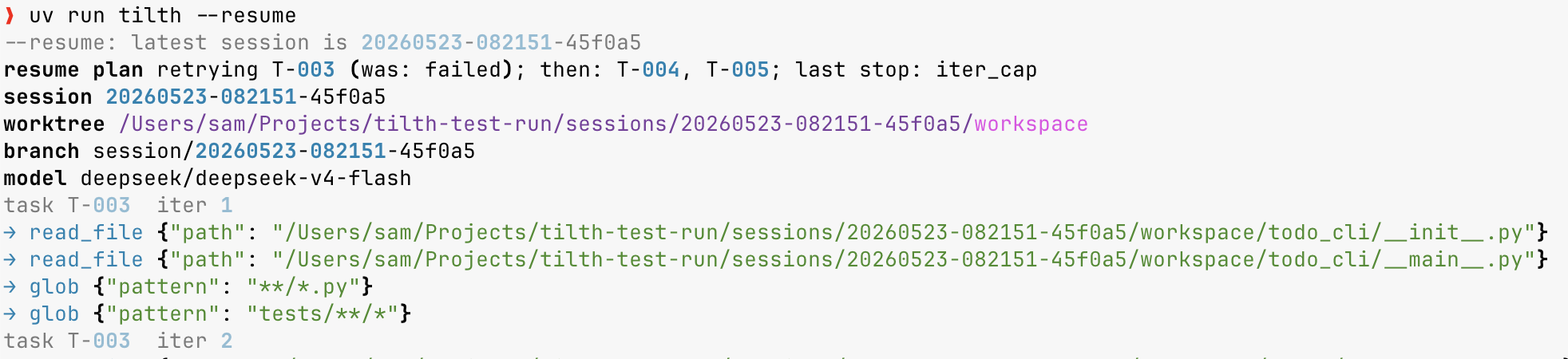
The plan banner spells out what's about to happen: T-003 retried with a fresh iteration budget, then T-004 and T-005 picked up in order. The iteration counter restarts at 1 — the bumped cap gives the retry 16 iterations to work with instead of the 8 that ran out last time.
What resume does
- Skips tasks already marked
doneinprd.json(which lives insessions/<id>/, not on the worktree branch). - Retries the trailing failed task, if any. Iter-cap, evaluator-cap, empty-response, and no-case stops mark the in-flight task
failedand write aFAILED (...)placeholder commit; resume flips that task back topendingand unwinds the placeholder so the retry sees the partial work as uncommitted changes (and the evaluator will see a single cumulative diff, not just the new edits). Wall-clock and token caps stop between tasks, so there's no failed task to unwind; interrupt leaves the sessionrunning, error leaves itfailed— neither marks a task failed. - Re-reads the per-task ledger. Each task's
sessions/<id>/ledger/<task_id>.jsonl(the evaluator's prior verdicts) survives on disk, so a resumed retry shows the worker and evaluator the verdict history from the run before — the live conversation is gone, the ledger is not. See The worker↔evaluator dialogue. - Resets the wall-clock budget for this resume — otherwise a resume the next day would trip
TILTH_MAX_WALL_CLOCK_MINUTESimmediately. - Preserves the token total. If the original run hit
TILTH_MAX_TOKENS, bump it in.envbefore resuming or the new run will stop on the first token check.
The resume plan is printed up front (which task is being retried, which are pending) and logged as a session_resume event in events.jsonl.
Diagram suggestion — timeline showing two runs of the same session glued together: first run hits a cap, then
tilth resumeresets the wall-clock baseline, retries the trailing failed task, then continues through pending tasks. Token total is shown as a single rising line across both runs; wall-clock is shown as two separate bars.
For the under-the-hood story of what resume actually mutates, see Resume mechanics.
Resumable-session detection
If you run uv run tilth run <workspace> and there's no prepared session for this workspace, the harness checks for a resumable prior session and offers an interactive picker rather than silently starting a new session:
No prepared session for this workspace, but a prior session is resumable:
  sessions/20260430-121316-51ead4/  failed     T-001: Scaffold CSVExporter  [last stop: iter_cap]

What would you like to do?
  1) resume that session
  2) discard it and prep a new one
  0) cancel
>
"Resumable" means: same source path AND last stop.reason is anything other than all_done (or no stop event was logged at all — covers crashes that died before logging) AND the session is not in prepared state (those get picked up directly by tilth run without a warning). The detection is read-only — it doesn't touch the prior session until you pick option 2.
When stdin isn't a TTY (CI, scripts, piped invocations) the picker is skipped — the harness exits 2 with a single-line pointer at tilth resume <sid> or tilth prep-feature <ws> so callers fail loudly instead of hanging on a prompt that nobody will ever answer.